Atomiser short, the resistance floor every cloud chaser runs into
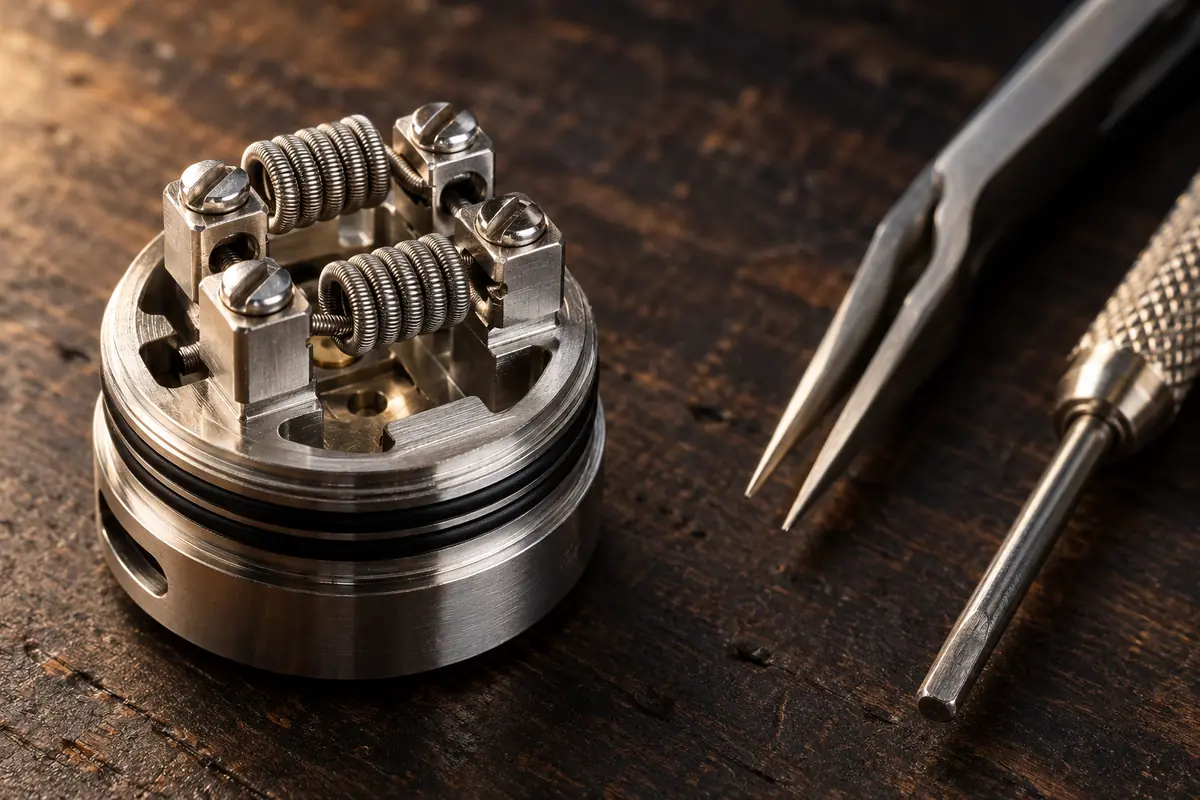
A tidy build, even wraps, two coils sitting in parallel on a wide deck, and the mod will not fire. The screen flashes an atomiser short warning even though nothing seems to touch. Cloud chasers know the scene well, because it plays out over a few hundredths of an ohm. The fault is not always a stray contact. Sometimes it comes down to a line that each mod draws for itself, and that Ohm’s law makes easy to read.
What triggers an atomiser short warning?
The atomiser short warning is a safety feature of the chip inside a regulated box mod. Before every firing, the electronics measure the resistance of the atomiser screwed onto the 510 connector. If the reading is close to zero, or below the floor set by the manufacturer, the mod refuses to send current and shows the message. Depending on the brand, the screen reads Atomizer Short, Short or Shorted.
Two very different situations therefore lead to the same screen. One is a genuine short circuit, meaning a direct contact between the positive pole and the ground (a coil leg brushing the deck, a 510 pin fouled with e-liquid). The other is a sound build that is simply too low for the mod carrying it. The first is fixed by taking things apart, the second by doing the maths.
If any of the build vocabulary feels hazy, our UK vape glossary covers resistance, decks and pins one by one.
A resistance floor set by Ohm’s law
Every box mod publishes the resistance range it accepts. The bottom figure is not arbitrary, it follows from what the chip and the batteries can deliver. Ohm’s law links voltage, current and resistance, and power follows from them. At the same wattage, the lower the resistance, the higher the current.
The Geekvape L200, also sold as the Aegis Legend 2, shows this almost to the hundredth. Its product page lists a range of 0.1 to 3 ohms, an output of 5 to 200 W and a maximum output current of 45 A. At 200 W on a 0.1 ohm coil, the current equals the square root of 200 divided by 0.1, roughly 44.7 A. The resistance floor therefore sits just under the chip’s current ceiling.
Below that floor, the numbers climb fast. The same 200 W setting on 0.05 ohm would call for about 63 A, well beyond what the chip is designed to supply. The atomiser short protection acts as a safeguard here, refusing a value the electronics could not drive across their full power range.
Dual-battery mods add a detail that is often misunderstood. Those 44.7 A flow through the coil, at the chip’s output, not through the batteries. A regulated mod converts its battery voltage, so the current it draws from the cells depends on the pack voltage. With two batteries in series, between 6 and 8.4 V (3 to 4.2 V per cell), 200 W calls for 23.8 to 33.3 A from each one, before conversion losses. That is the level, with the cells nearly flat, at which their discharge rating should be read.
Not every mod draws the line in the same place. The Vaporesso Gen X manual gives a range of 0.03 to 5 ohms for an output of 5 to 220 W, without stating a maximum current. At 0.03 ohm, reaching 220 W would take close to 86 A. A very low floor does not, on its own, tell you how much power the mod really delivers on an extreme build.
When a cloud chasing build drops below the floor
Cloud chasing naturally pushes resistance down, with more heating surface, more wattage and builds that multiply the wire on the deck. Two mechanisms explain most refusals on a build that is otherwise clean.
Parallel coils divide the value
Two identical coils fitted in parallel on a dual-coil deck give half the value of either one. So two 0.2 ohm coils come down to 0.1 ohm, right on the L200 floor, and two 0.15 ohm coils to 0.075 ohm, below it. On a quad-coil deck, four 0.4 ohm coils also land at 0.1 ohm.
The figure to check is never that of a single coil. What matters is the total value the mod reads once every leg is clamped.
Thicker wire, lower resistance
A wire’s resistance rises with its length and falls with its cross-section. A clapton or a thick wire wound with few wraps gives a low reading. Adding a wrap or choosing a thinner wire raises the value instead, which keeps the build above the floor without changing deck.
Mechs and regulated mods, two cultures of the short
Before chipsets became the norm, a good share of cloud chasers built on mechanical mods. A mech has no electronics, it connects the battery to the atomiser through a plain contact. Nothing is measured, nothing is displayed, and a short goes through without any message at all.
The regulated mod moved that check onto the chip. The reading a builder used to take on an ohm meter before vaping is now repeated at every press of the fire button. That is why the atomiser short warning is as much a nuisance as a help in cloud chasing circles, since it rules out values some people once ran with no safety net.
Getting a build back above the atomiser short threshold
When the warning appears, the order of checks matters. Look for a dead short first, because no calculation will fix one. Reading the value on an ohm meter, or on the screen of another mod, is enough. A reading near zero points to a stray contact, while a steady but low reading points to a build under the floor.
In the second case, there are three levers. Removing one coil from a parallel dual build doubles the value. Adding a wrap or moving to a thinner wire raises it by a few hundredths. Switching to a mod with a lower floor is possible too, provided you check its maximum current and the discharge rating of its batteries, not just its resistance range.
Bypassing the chip makes no sense, though. A value the mod rejects is rejected for an electrical reason, and forcing it means asking the battery for a current the whole setup was not built for.
FAQ
These questions come up in searches around the message and under retailer listings. The answers stick to electrical principles and to manufacturer documents.
Does short circuit mean the same as atomiser short?
In most cases, yes. Short circuit, Shorted and Atomizer Short all describe a value that is too low or a direct contact between the poles. The wording depends on the brand and the firmware, not on how serious the fault is.
What should I do if the mod no longer detects the atomiser?
That is the opposite fault. A No Atomizer type of message points to an infinite reading, so an open circuit (a loose leg, a cut wire, a 510 pin that no longer makes contact). The job is to find the missing contact, not an extra one.
Does a reading that changes from one puff to the next mean a short?
Not necessarily. A jumping reading usually gives away mechanical play, such as a loose deck screw or an atomiser moving on the 510. A build sitting right on the floor can also switch between firing and refusing, which is a reason to raise it by a few hundredths.
Does a very low resistance coil heat up faster?
Not as such. At the same wattage, a low value draws more current, but it is the wattage you set that heats the wire. A thick wire ramps up more slowly than a thin one. Too much power for the cotton shows up as a burnt taste, which has nothing to do with the protection.
What total resistance should a dual-coil build aim for?
There is no single figure. The rule is to work out the value of the complete build, keep it above your mod’s floor with a margin of a few hundredths, then check that the current needed at your chosen wattage stays under the stated maximum.
Atomiser short, a line worth reading before you build
The message does not always mean a fault. On a cloud chasing build, it often signals that the total value has crossed the floor the mod sets for itself, a floor that follows from its maximum current. Working out the resistance of a dual-coil build before clamping the legs avoids most refusals.
An atomiser short warning also tells the story of how cloud chasing culture adapted to chipsets. The sum once worked out at the bench now shows up on the screen, and knowing it helps explain what a mod will accept, and why.
Further reading
Editorial content for adult readers only. Vaping products can contain nicotine, which is a highly addictive substance. Vaping products are not for sale to anyone under 18 in the UK. This article is not a buying recommendation.